
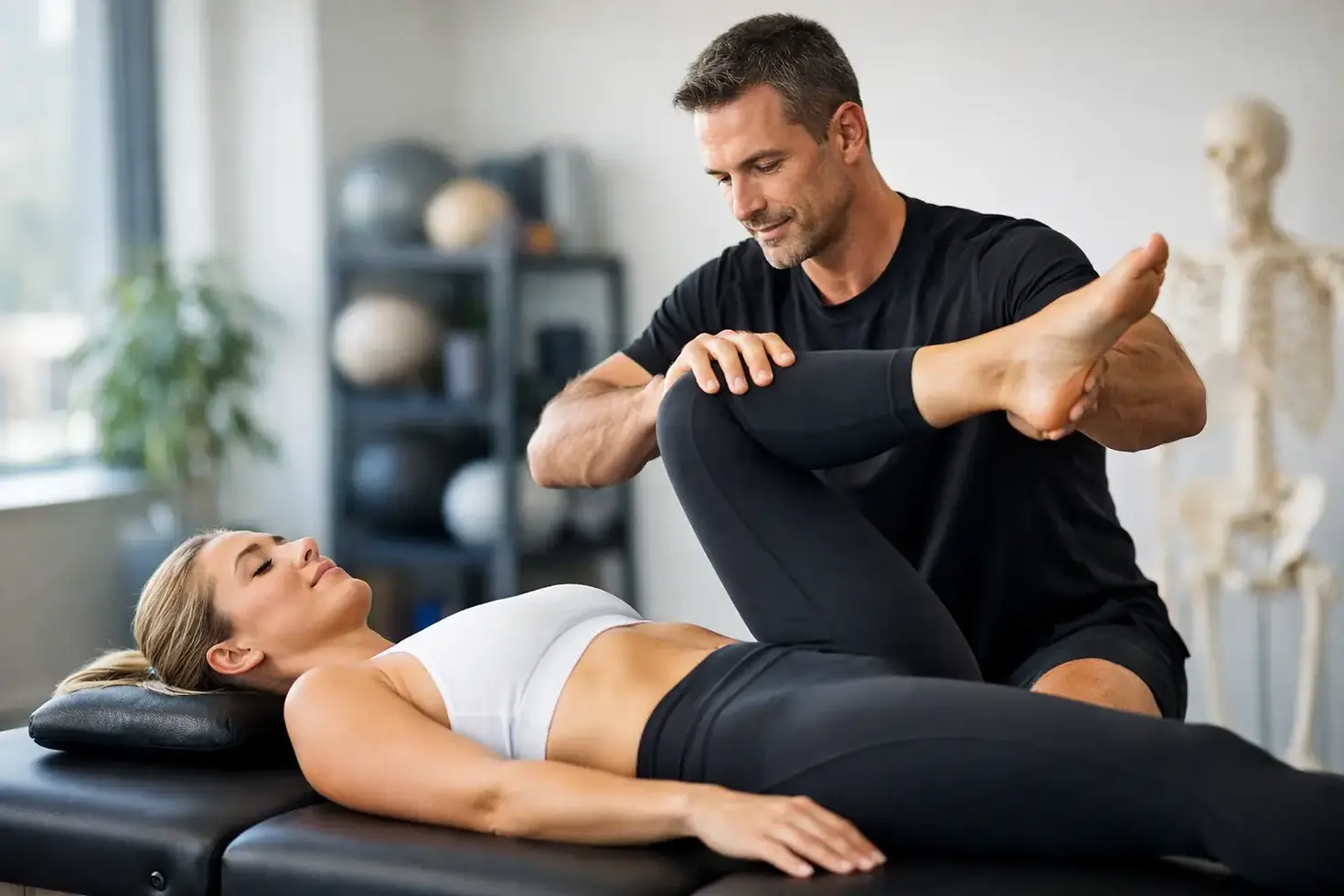
What Fascial Stretch Can Do for Mobility
You notice it when you stand up after a long day at your desk, when your hips feel tight halfway through a run, or when your shoulders never quite loosen up no matter how much you stretch. Fascial stretch work is often helpful in these situations because it focuses on the connective tissue around muscles and joints, not just the muscles themselves.
For many people, stiffness is not simply about being "tight." It can be tied to posture, old injuries, repetitive movement, training load, or long hours spent sitting. That is why a basic stretching routine does not always create lasting change. A more targeted, hands-on approach may be a better fit when mobility restrictions keep coming back.
What is fascial stretch therapy?
Fascial stretch therapy is a guided, table-based treatment designed to improve mobility, reduce tension, and help the body move more freely. It uses assisted stretching, traction, and gentle movement patterns to target fascia, muscles, and joints together.
Fascia is the connective tissue that wraps around muscles, bones, nerves, and organs. It helps support movement, but it can also contribute to restriction when the body has been under stress from overuse, inactivity, injury, or compensation patterns. When fascia loses some of its normal glide, movement can feel limited or uncomfortable.
This is one reason a person can feel stiff even if they already stretch regularly. If the issue involves joint mechanics, nervous system guarding, or connective tissue restriction, isolated static stretching may only do so much. Fascial stretch therapy aims to address the bigger picture.
How fascial stretch differs from regular stretching
Traditional stretching is often self-directed. You hold a position, feel a pull, and wait for the muscle to relax. That can be useful, especially for general flexibility, but it has limits.
A fascial stretch session is more interactive. The provider moves your body through specific angles and planes of motion while stabilizing certain areas and unloading others. The goal is not to force a deeper stretch. It is to help the body accept movement with less resistance.
That distinction matters. If stretching feels aggressive, the body may tighten up instead of letting go. Assisted fascial work is usually more effective when it is precise and controlled, with attention paid to breathing, joint position, and how one restriction may be affecting another area.
For example, a person with recurring low back tightness may actually have limited hip mobility and poor movement through the front of the hips. Someone with persistent neck tension may also have restricted rib cage or shoulder mechanics. In those cases, chasing the sore spot alone often misses the source of the problem.
Who may benefit from a fascial stretch approach?
Fascial stretch therapy can be useful for a wide range of people, especially those dealing with stiffness, reduced range of motion, or movement that feels uneven. Office workers often seek it out for neck, back, and hip tension related to prolonged sitting. Active adults and athletes may benefit when training leaves them feeling compressed, restricted, or slow to recover.
It can also be appropriate as part of a rehab plan after injury, especially when pain has improved but mobility has not fully returned. In some cases, people are not looking for pain relief alone. They want to move better during workouts, sleep more comfortably, or get through the workday without feeling locked up by mid-afternoon.
That said, it is not the right starting point for every condition. If a joint is acutely inflamed, a tissue is healing, or symptoms point to a more complex injury, treatment should be selected carefully. This is where working with a clinic that can assess movement and coordinate care across disciplines makes a real difference.
What happens during a fascial stretch session?
Most sessions take place on a treatment table, with the patient remaining relaxed while the practitioner guides movement. Straps may be used for comfort and stability so the body can fully let go instead of trying to brace.
The session usually begins with a quick conversation about symptoms, injuries, and movement goals. From there, the provider assesses how key areas are moving - often the hips, spine, shoulders, and surrounding tissue chains. Treatment is then tailored to the individual rather than delivered as a fixed routine.
During the session, you may notice a mix of stretching, traction, gentle oscillation, and movement through multiple directions. Many people expect it to feel intense, but effective treatment is often smooth rather than forceful. You should feel a sense of opening or release, not the kind of sharp discomfort that makes you hold your breath.
Some people feel an immediate difference when they stand up. Others notice more change over a series of visits, especially if restrictions have built up over months or years. The best results usually come when hands-on care is paired with exercises or movement strategies that help maintain the gains between appointments.
Common reasons people seek fascial stretch therapy
Hip tightness is one of the most common concerns. This can show up in runners, cyclists, gym-goers, and people who spend most of the day seated. Limited hip mobility often affects the low back and knees, so improving it can change more than one symptom at a time.
Shoulder restriction is another frequent issue, especially for people who work at a computer or train overhead. When the shoulder blade, upper back, and rib cage are not moving well together, the shoulder can feel stiff, pinchy, or weak. Assisted fascial work may help restore motion in a more integrated way than isolated stretching alone.
Low back tension, neck stiffness, and general postural tightness also bring many people in. In these cases, treatment often focuses on reducing protective tension while improving how the surrounding joints and tissue lines move together.
Athletes sometimes use fascial stretch therapy for performance support, but not in the way marketing language usually suggests. It is not a magic fix. What it can do is help improve movement quality, reduce the feeling of restriction, and make it easier to train with better mechanics.
Where fascial stretch fits in a rehab plan
For some patients, fascial stretch therapy works well as a stand-alone service. For others, it is most effective when integrated with physiotherapy, chiropractic care, massage therapy, or corrective exercise.
That depends on what is driving the problem. If mobility loss is the main issue, assisted stretching may be enough to create noticeable relief. If pain is tied to weakness, joint irritation, a disc issue, or a repetitive strain pattern, then mobility work should be part of a larger plan instead of the whole plan.
This is often where coordinated care is most valuable. A patient recovering from a sports injury may benefit from physiotherapy for strength and loading, massage therapy for soft tissue work, and fascial stretch sessions to restore range of motion that feels stuck. Someone with chronic desk-related tension may respond best to a mix of hands-on treatment and practical home strategies that fit a busy schedule.
At a multidisciplinary clinic like Kinetica Health Group, that kind of coordination helps patients avoid the stop-start cycle of trying one isolated treatment after another.
Is fascial stretch therapy safe?
In the right hands, fascial stretch therapy is generally well tolerated. The key is proper assessment and appropriate technique. A provider should understand when mobility work is indicated and when another approach is safer or more useful.
There are times when caution is needed, including recent surgery, acute injury, fracture, severe osteoporosis, certain connective tissue disorders, or active nerve irritation. Pregnancy, hypermobility, and inflammatory conditions may also require modifications. More stretch is not always better, and treatment should never be based on pushing through pain.
If you are unsure whether this approach makes sense for your symptoms, a professional assessment is the best place to start. That helps clarify whether the issue is really tissue restriction, joint limitation, movement control, or a combination of all three.
What results should you expect?
A good fascial stretch session often leaves people feeling lighter, less compressed, and able to move with less effort. You may notice easier rotation, deeper squat depth, a longer stride, or less pulling in everyday movements.
Still, results vary. Some restrictions respond quickly. Others return unless the underlying cause is addressed. If your job keeps you seated for ten hours a day, or your training program keeps overloading the same pattern, hands-on therapy alone will not hold forever.
That is not a drawback of the treatment. It is just how recovery works. Lasting improvement usually comes from matching the right therapy to the right problem, then supporting it with consistent movement habits.
If your body feels stiff in ways that ordinary stretching has not changed, that is worth paying attention to. Sometimes the next step is not doing more on your own. It is getting a more specific plan that helps your body move the way it is supposed to again.


Comments